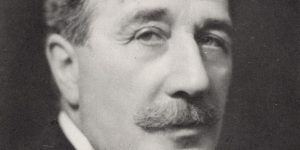
He failed the entrance exam for the École Normale Supérieure the first time – too unconventional, some would say. He came first in the philosophy agrégation the following year. In 1964, he refused the Nobel Prize in Literature. Fifty thousand people followed his funeral procession to Montparnasse Cemetery in 1980. Jean-Paul Sartre is the most influential public intellectual the École Normale Supérieure has ever produced – and probably the most difficult to categorize.
Jean-Paul Sartre at the ENS Ulm: an initial failure, then first in the agrégation exam
Jean-Paul Charles Aymard Sartre was born on June 21, 1905, in Paris. His father, a naval officer, died when he was fifteen months old. He grew up with his maternal grandparents in Meudon, in a house full of books. His grandfather, Charles Schweitzer, a German teacher, read and worked in front of him without directly teaching him – Sartre would later say that this was how he learned to read: by watching an adult become passionate about words.
At the Lycée Henri-IV, he met Paul Nizan, who would become his closest friend. Together, they prepared for the entrance exam to the École Normale Supérieure. Sartre failed the first time in 1928—his approach to the topics was too original, his method too unconventional. He took it again in 1929 and came first. He passed the agrégation in philosophy the same year, also coming first. Simone de Beauvoir came second. She would never forget this ranking—and neither would he.
At the ENS, Sartre rubbed shoulders with Raymond Aron, Georges Canguilhem, and Paul Nizan – all thinkers who would traverse the 20th century, sometimes in opposition to him. It was a class of rare intellectual depth, even for a school accustomed to producing such figures.
Read more: Sciences Po Paris: the 2025 academic year will be marked by excellence – Planète Grandes Écoles
What the ENS Ulm gave to Sartre – and what he did with it
The ENS instilled in him the conceptual rigor of the French philosophical tradition – the ability to sustain an argument over hundreds of pages without losing the thread, to construct a coherent system from simple premises. This is most spectacularly demonstrated in Being and Nothingness (1943): 722 pages of phenomenological ontology, written largely during the Occupation, in the cafés of Saint-Germain-des-Prés.
What he did with this legacy is another matter. The École Normale Supérieure (ENS) trains people who are part of a tradition. Sartre chose to use the tools of this tradition to dismantle it. Husserl's phenomenology, which he studied in Berlin in 1933-34 on a scholarship, provided him with the method. Existentialism—"existence precedes essence"—is the conclusion he draws from it, a conclusion that turns two centuries of idealist philosophy inside out.


Read more: Georges Pompidou, ENS Paris (Ulm) – Alumnow
Nausea, Being and Nothingness, and the Invention of Existentialism
After graduating from the École Normale Supérieure, Sartre taught in secondary schools—in Le Havre, Laon, and then Paris—for about ten years. It was during these teaching years that he wrote his first works. Nausea was published in 1938: Roquentin, his character, experiences the absurdity of existence while looking at a tree root. The novel was critically acclaimed. The Wall (1939), a collection of short stories, confirmed his unique literary voice.
Mobilization in 1939, captivity in 1940—he was taken prisoner at Padoux—and liberation in 1941 did not interrupt his writing. Being and Nothingness was published in 1943. The central formula—"existence precedes essence"—would become one of the most quoted philosophical statements of the 20th century. It means: there is no pre-existing human nature, no destiny, no essence fixed by God or by biology. Human beings are defined by what they do, not by what they are supposed to be.
This seemingly abstract idea had massive political and cultural consequences. It legitimized individual emancipation, the rejection of determinism, and the refusal of assigned identities. It nourished generations of activists—feminists, decolonialists, existentialists of all kinds—who sometimes hadn't read a single line of Sartre but breathed the air he had helped to create.
Read more: Aimé Césaire, ENS Paris (Ulm) – Alumnow
Modern Times, the Nobel Prize refused, and death in front of fifty thousand people
In 1945, with Simone de Beauvoir, Raymond Aron, and Maurice Merleau-Ponty, Sartre founded the journal Les Temps modernes. It would last for decades and become the leading voice of the engaged French intelligentsia. From this platform, he took positions on the Cold War, colonialism, Cuba, and Vietnam—often controversial, always uncompromising.
In 1964, the Swedish Academy awarded him the Nobel Prize in Literature. He refused it. His official justification: he did not want "to be transformed into an institution." He also expressed reservations about the fact that this prize had historically been awarded to Western authors to the detriment of writers from the developing world. This refusal remains, to this day, the most discussed symbolic gesture in 20th-century French intellectual life. That same year, he published *Les Mots* (The Words), an autobiography of his childhood, in which he dismantles, with relentless lucidity, his own illusions as a writer.
Jean-Paul Sartre died on April 15, 1980, in Paris, of pulmonary edema, at the age of 74. He had been nearly blind for several years. Fifty thousand people followed his funeral procession to Montparnasse Cemetery without any prior organization—the crowd had formed spontaneously. This figure says something about what it means, in France, to be a public intellectual. The École Normale Supérieure had produced a professor of philosophy. He had become something else.
Frequently Asked Questions about Jean-Paul Sartre
What school did Jean-Paul Sartre attend?
Jean-Paul Sartre entered the École Normale Supérieure on rue d'Ulm (ENS Paris) in 1929, after initially failing the entrance exam in 1928. He graduated first in his class in the philosophy agrégation examination that same year. He then spent time in Berlin in 1933-34 studying Husserlian phenomenology, which would influence his entire body of work.
Why did Jean-Paul Sartre refuse the Nobel Prize?
Sartre refused the 1964 Nobel Prize in Literature, declaring that he did not want "to be transformed into an institution." He also criticized the fact that the prize was awarded primarily to Western authors. This refusal remains the only one in the history of the Nobel Prize in Literature—the other laureates who were unable to receive it were forced to do so by external circumstances.
What is Jean-Paul Sartre's main work?
Sartre's central philosophical work is Being and Nothingness (1943), an essay in phenomenological ontology that develops the foundations of existentialism around the formula "existence precedes essence." In literary terms, Nausea (1938) and The Words (1964) are his most widely read works. He also wrote plays—No Exit, The Flies—which reached a much wider audience than his philosophical writings.