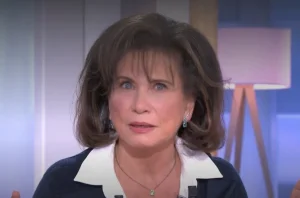
She failed the ENA entrance exam twice. She was a member of the French synchronized swimming team at 16. She headed the world's leading law firm, then the IMF, then the European Central Bank. Christine Lagarde is perhaps the Sciences Po alumna whose career path least resembles what the school was supposed to produce – and most closely resembles what it is truly capable of.
Christine Lagarde at Sciences Po Aix: America first, then the IEP
Christine Madeleine Odette Lallouette was born on January 1, 1956, in Paris. Her father, an English teacher at a high school in Le Havre, died of ALS (Lou Gehrig's disease) when she was 16. Her mother, a professor of classical literature, raised four children alone. This background instilled in her a strong sense of responsibility from an early age.
At 17, she received a scholarship to study for a year in the United States, at Holton Arms School in Bethesda, Maryland. There, she completed an internship as a parliamentary assistant at the Capitol. The experience was pivotal. Her father had introduced her to English literature; she spoke the language poorly. This stay, she would later say, became a path to him—and completely changed her worldview.
Upon returning to France, she enrolled at the Institute of Political Studies in Aix-en-Provence – Sciences Po Aix – from which she graduated in 1977. She was also a member of the French synchronized swimming team during her high school years – a detail that few CVs in the French civil service can boast.
Read more: Sciences Po Paris: the 2025 academic year will be marked by excellence – Planète Grandes Écoles
Lagarde and the ENA: two failures, a decisive pivot towards law
After graduating from Sciences Po Aix, Christine Lagarde took the entrance exam for the ENA (National School of Administration). She failed. She tried again. She failed again. Two consecutive failures in this exam generally signify the end of an institutional career. Lagarde drew a different conclusion.
She earned a master's degree in English, a master's degree in business law, and a postgraduate diploma (DESS) in labor law from Paris X-Nanterre University. In 1981, she joined Baker McKenzie, one of the world's leading American business law firms. Her specialty: labor law and antitrust law. A technical, demanding, and unglamorous field. Exactly the kind of place where a career is built over time rather than through flashy success.


Read more: Jacques Chirac, Sciences Po Paris – Alumnow
Baker McKenzie: 25 years to become the first woman to lead a global law firm
Lagarde spent twenty-five years at Baker McKenzie. Partner in the Paris office in 1987, managing partner in 1991, member of the global executive committee in Chicago in 1995. In 1999, she became chair of the global executive committee – the first woman in this position, in a firm which then had thousands of lawyers in several dozen countries.
This career path, built without the ENA, without the network of elite corps, from an American firm rather than from the corridors of Bercy, gives him something that his counterparts trained at the ENA do not always have: a vision of the economic world from companies, not from administrations.
Read more: Emmanuel Macron, Sciences Po Paris – Alumnow
Minister, Managing Director of the IMF, President of the ECB: three firsts for women in three institutions
In 2005, Jean-Pierre Raffarin convinced her to join the Villepin government as Minister Delegate for Foreign Trade. Two days after her appointment, she declared that the French Labor Code was "complicated, cumbersome, and a hindrance to hiring." She received an immediate reprimand from the Prime Minister. She did not change her position.
Under Nicolas Sarkozy, in June 2007 she became the first female Minister of Economy and Finance of a G7 country. She managed the banking and financial crisis of autumn 2008 from Bercy, in a context of global panic that few European ministers had anticipated.
In July 2011, following Dominique Strauss-Kahn's legal troubles, she was appointed Managing Director of the IMF – the first woman to hold this position. Two terms, the Greek debt crisis, and tensions with creditors followed. In November 2019, she became President of the European Central Bank – again, the first woman. Since then, she has steered the monetary policy of the eurozone, of which the 2022-2023 interest rate hikes in response to inflation remain the most closely watched episode of her tenure.
For alumni of Sciences Po Aix and other French IEPs (Institutes of Political Studies), her career demonstrates that the ENA (National School of Administration) is not the only path to global leadership positions. She built her authority through longevity, technical expertise, and an ability to establish herself as the leader in institutions that had never before had a woman at their helm. Three times. In three different institutions.
Frequently asked questions about Christine Lagarde
Which school did Christine Lagarde attend?
Christine Lagarde graduated from the Institute of Political Studies in Aix-en-Provence (Sciences Po Aix), class of 1977. She then obtained two master's degrees (English and business law) and a postgraduate diploma in social law from the University of Paris X-Nanterre, after failing twice in the ENA entrance exam.
Did Christine Lagarde fail the ENA entrance exam?
Yes. Christine Lagarde failed the entrance exam for the ENA twice. She turned to business law and joined Baker McKenzie in 1981. This pivot proved decisive for her international rise.
What international positions has Christine Lagarde held?
Christine Lagarde was chair of Baker McKenzie's global executive committee (1999-2004), managing director of the IMF (2011-2019) and has been president of the European Central Bank since November 2019. She was the first woman to hold each of these three positions.