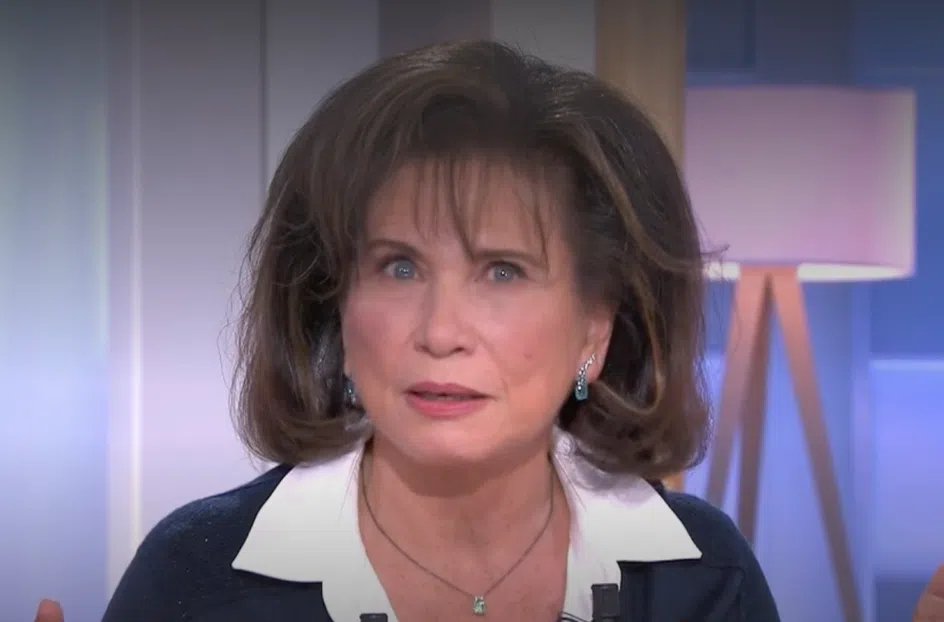
Her birth name was Schwartz. Her father changed it to Sinclair in 1949, after serving in the Free French Forces. Her maternal grandfather, Paul Rosenberg, was the art dealer who represented Picasso, Braque, and Matisse in pre-war Paris. She knew at age 10 that she wanted to be a journalist. She studied at Sciences Po . And for 13 years, every Sunday evening on TF1, all of France watched 7 sur 7.
Anne Sinclair at Sciences Po Paris: New York, war, and a vocation at age 10
Anne-Élise Schwartz was born on July 15, 1948, in New York City. Her parents had fled France during the Occupation—her family, of Jewish origin, had lost everything. Her paternal grandfather, Léonce Schwartz, had been arrested during the "roundup of notables" and deported to Auschwitz. Her maternal grandfather, Paul Rosenberg, an art dealer whose gallery on Rue La Boétie in Paris represented Picasso, Braque, and Matisse, had managed to escape to the United States with part of his collection. The family returned to Paris in 1951. Her father took the name Sinclair.
She attended the Hattemer school in Paris – vying for first place with Jean-Jacques Chaban-Delmas – and had Véronique Sanson in her sixth-grade class. At eight, she wanted to be a dancer and opera singer. At ten, she listened to Europe 1 every day on her way home from school and knew she wanted to be a journalist. She would never change her mind.
A graduate of Sciences Po Paris in 1972 (Political and Social Studies track), she furthered her education with a law degree from Paris-Nanterre University, a Master's degree in Political Science, and a doctorate in law. This comprehensive academic background provided her with knowledge of institutions, constitutional law, and political issues, which would become the foundation of her entire career as an interviewer.
Read more: Sciences Po Paris: the 2025 academic year will be marked by excellence – Planète Grandes Écoles
Anne Sinclair from Europe 1 to 7 sur 7: thirteen years interviewing French politicians
In 1973, Anne Sinclair joined Europe 1 as a journalist. In 1976, she moved to FR3. In 1981, she joined TF1. And in 1984, she took over the presentation of 7 sur 7, the Sunday evening political program. She hosted it for 13 years, until 1997.
7 sur 7 is a simple yet formidable format: a political figure, an hour-long one-on-one interview, without a co-host. Anne Sinclair asks the questions. She doesn't get flustered. She doesn't interrupt. She comes back. For thirteen years, every president, prime minister, minister, and party leader sat in that chair opposite her. François Mitterrand, Jacques Chirac, Michel Rocard, Édith Cresson, Valéry Giscard d'Estaing, Margaret Thatcher, Mikhail Gorbachev – the list of interviews reads like a summary of the political history of the 1980s and 1990s.


During this period, polls consistently ranked her among the most popular French journalists. Her interviewing style—demanding without being aggressive, well-informed, and able to follow up without interrupting—was a masterclass in itself. She received the Sept d'Or award for best journalist in 1989.
Read more: Emmanuel Macron, Sciences Po Paris, President of the Republic – Alumnow
Anne Sinclair, DSK and the 2011 affair: a year in the world's spotlight
In 1991, she married Dominique Strauss-Kahn, an economist and socialist politician. Their marriage lasted twenty-two years. In 2007, Strauss-Kahn was appointed managing director of the International Monetary Fund in Washington. She accompanied him. In May 2011, in New York, Strauss-Kahn was arrested on charges of sexual assault. The case became the most talked-about legal and media sensation in the world for several weeks.
Anne Sinclair publicly supported her husband in the early days of the case—attending every hearing and paying his bail. This stance earned her harsh criticism in some of the French and international press. The charges were later dropped by the Manhattan District Attorney. The couple separated in 2013. In subsequent interviews, she said she had trusted someone she thought she knew and paid the price for misplaced loyalty.
Read more: Christine Lagarde, Sciences Po, President of the ECB – Alumnow
Sinclair at HuffPost and the book about Paul Rosenberg
In January 2012, Anne Sinclair launched the French version of HuffPost and took over as editorial director. She led the editorial team until 2019. This move into the digital world demonstrates an ability to reinvent herself – transitioning from television to online journalism, from interviewer to editor-in-chief, at the age of 64.
In 2012, she published "21 rue La Boétie"—the story of her grandfather, Paul Rosenberg, and his Parisian art gallery. The building on rue La Boétie, where Rosenberg had represented Picasso and Braque, had been confiscated by the Nazis during the Occupation and requisitioned by the Institute for the Study of Jewish Questions. The book recounts the history of this looting, the subsequent exile, and the dispersal of the collection. It became a traveling exhibition presented in several international museums.
For Sciences Po Paris alumni, Anne Sinclair embodies something the school values but doesn't always produce: the political journalist who knew how to ask the right questions at the right time for three decades, without ever losing the rigor or objectivity her education instilled in her. "7 sur 7" wasn't a battleground program—it was a program of precision. Sciences Po had cultivated that too.
Frequently asked questions about Anne Sinclair
Which school did Anne Sinclair attend?
Anne Sinclair is a graduate of Sciences Po Paris (Political and Social Sciences track, class of 1972). She also has a law degree from Paris-Nanterre University, a DEA in political science and a doctorate in law.
How many years did Anne Sinclair host 7 sur 7?
Anne Sinclair hosted the program "7 sur 7" on TF1 for 13 years, from 1984 to 1997. The show, broadcast on Sunday evenings, featured one-on-one interviews with the most influential French and international political figures. She received the Sept d'Or award for best journalist in 1989.
What is Anne Sinclair's connection to Paul Rosenberg?
Paul Rosenberg is Anne Sinclair's maternal grandfather. A renowned Parisian art dealer, he represented Picasso, Braque, and Matisse in his gallery at 21 rue La Boétie in Paris before the war. The gallery was confiscated by the Nazis during the Occupation. Anne Sinclair dedicated a book to him in 2012, which also became a traveling exhibition presented in several international museums.