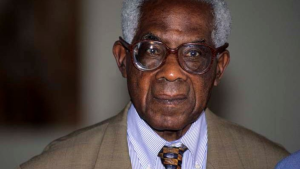
In 1950, Laurent Schwartz received the Fields Medal—the highest distinction in mathematics, the equivalent of the Nobel Prize. He was the first Frenchman to receive it. He was unable to collect it at Harvard: his Trotskyist past had resulted in a ban on his American visa. This anecdote speaks volumes about a man who had been a graduate of the École Normale Supérieure, a mathematical genius, an anti-colonial activist, a butterfly collector, and who had refused throughout his life to choose between these identities.
Laurent Schwartz at the ENS Paris: a family of scholars, an early vocation
Laurent Moïse Schwartz was born on March 5, 1915, in Paris, into a Jewish family of Alsatian origin entirely devoted to science and medicine. His father, Anselme, was a surgeon at the Paris hospitals. His maternal uncle, Robert Debré, was the pediatrician who founded UNICEF. His great-uncle by marriage, Jacques Hadamard, was one of the most important mathematicians of his generation. In this family, conversations revolved around science, medicine, and ideas.
He attended secondary school at the Lycée Janson-de-Sailly, excelling in Latin, Greek, and mathematics. His seventh-grade teacher had told his parents, "Be careful, people will say your son is gifted in languages, when in fact he's only interested in the scientific and mathematical aspects of them." In 1932, he obtained his baccalaureate. He then attended preparatory classes at the Lycée Louis-le-Grand. In 1934, he entered the École Normale Supérieure (ENS) on Rue d'Ulm. In 1937, he passed the agrégation examination in mathematics. It was at the ENS that he began attending the seminars of Paul Lévy—whose daughter, Marie-Hélène, herself a mathematician, he married in 1938.
Read more: In 2024-2025, the ENS and its research are taking an impact-oriented turn – Planète Grandes Écoles
Schwartz, the night of November 1944, and the theory of distributions
His thesis was defended in 1943, in the midst of the war, while he was hiding under a false identity – as a Trotskyist of Jewish origin, he was doubly threatened. He found refuge in Clermont-Ferrand, where the University of Strasbourg had been relocated, and it was there that he met André Weil and the Bourbaki group.
It was also there, during a night in November 1944, that he had the central intuition of his career. Mathematicians had been trying for years to legitimize the calculations used by physicists like Dirac and Heaviside, who were manipulating mathematically inconsistent objects – notably the "delta function", zero everywhere except at a point where it equals infinity, and with an integral equal to 1. That night, Schwartz had invented the notion of distribution – a rigorous generalization of the function that made all these calculations legitimate.
He had developed this theory over four years, teaching in Grenoble and then Nancy. Distribution theory had become a fundamental tool for partial differential equations, the Fourier transform, theoretical physics, and quantum mechanics. He later recounted that that night had been one of the two best of his life—the other being the night he captured 450 butterflies.


Read more: Cédric Villani, ENS Paris (Ulm), Fields Medalist and mathematician – Alumnow
Schwartz's Fields Medal and the visa refused by the United States
In 1950, at the International Congress of Mathematicians at Harvard, the Fields Medal was awarded to Laurent Schwartz for his work on distributions. It was the first time a Frenchman had received this distinction—and Schwartz was unable to travel to Harvard to accept it. American authorities had denied him a visa because of his Trotskyist past. His political involvement in the 1930s, which he had broken in 1947, continued to close doors for him ten years later.
Appointed professor at the École Polytechnique in 1958, he revamped the mathematics curriculum there and created a research center that would become one of the best in the world. But in 1961, he signed the Manifesto of the 121—the petition in favor of the right to conscientious objection during the Algerian War. Polytechnique, a military institution, immediately suspended him from his teaching duties. He did not resume his position until 1963.
Laurent Schwartz, the OAS, butterflies and the end of a life
His anti-colonial activism had consequences beyond the academic sphere. In February 1962, his son Marc-André, then in his early twenties, was kidnapped by an OAS commando and held for two days. The shock was immense. Marc-André was eventually released but never fully recovered. He died in 1971. The pain of this loss profoundly affected Schwartz for the rest of his life.
Alongside all of this—mathematics, political activism, and teaching at Polytechnique for twenty years—he cultivated a lifelong passion for entomology and butterflies. His personal collection, bequeathed after his death to the National Museum of Natural History, the Lyon Museum, the Toulouse Museum, and the Cochabamba Museum in Bolivia, comprised nearly 20,000 specimens. Several species bear his name.
Laurent Schwartz died on July 4, 2002, in Paris, at the age of 87. He titled his autobiography, published in 1997, "A Mathematician Grappling with the Century." The title was apt: he had been a graduate of the École Normale Supérieure, a mathematical genius, a Trotskyist, the husband of a mathematician, an anti-colonial activist, a reformist teacher, a butterfly collector, and a grieving father. The École Normale Supérieure had shaped him. He had made the most of what it had given him.
Frequently Asked Questions about Laurent Schwartz
Which school did Laurent Schwartz attend?
Laurent Schwartz entered the École Normale Supérieure on rue d'Ulm in 1934, after preparatory classes at the Lycée Louis-le-Grand. He obtained the agrégation in mathematics in 1937. He then defended his thesis in 1943 and taught in Grenoble, Nancy, Paris and the École Polytechnique.
Why was Laurent Schwartz unable to collect his Fields Medal?
The Fields Medal had been awarded to Laurent Schwartz in 1950 for his work on distribution theory, but he was unable to travel to Harvard to receive it: the American authorities had refused him a visa because of his former Trotskyist involvement in the 1930s. He remained the first Frenchman to have received this distinction.
What is Laurent Schwartz's theory of distributions?
Distribution theory, invented by Laurent Schwartz during a November night in 1944, is a rigorous generalization of the concept of a function that allows for a precise mathematical meaning to be given to the calculations used by physicists such as Dirac and Heaviside. It has become a fundamental tool for partial differential equations, theoretical physics, and quantum mechanics, and is used daily in all branches of physics and applied mathematics.