He ranked 7th in the 1992 entrance exam for the École Polytechnique. He had also ranked 4th at the École Normale Supérieure (ENS). He chose the ENS. His parents would have preferred him to attend Polytechnique. He, however, understood at Louis-le-Grand that the ENS was his destiny. Cédric Villani received the Fields Medal in 2010—the equivalent of the Nobel Prize in mathematics—at the age of 37. The press dubbed him "the Lady Gaga of mathematics." He didn't object.
Villani at the ENS Paris: the choice of school, the discovery of style
Cédric Patrice Thierry Villani was born on October 5, 1973 in Brive-la-Gaillarde. He grew up in an intellectual environment – his father was an engineer, his mother a schoolteacher – and attended secondary school in Toulon, at the Lycée Dumont-d'Urville. He obtained his baccalaureate with the highest average in the academy.
At Louis-le-Grand, in his preparatory science class, he discovered the existence of the ENS: his classmates spoke of it "as if it were a given" for him. His mother had never heard of it. He took both entrance exams in 1992: 4th for the ENS, 7th for Polytechnique. He chose the ENS. "If I had to do it all over again, I would do everything exactly the same way," he would say years later.
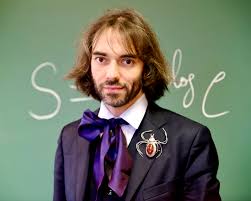
It was during his four years at the École Normale Supérieure that he adopted the sartorial style that would bring him public notoriety: the cravat, retro suits, and the spider brooch—he had been passionate about arachnology since childhood. This wasn't just a pose. He was someone who decided very early on that he wouldn't inhabit the world like everyone else. A species of spider, Araniella villanii, was named in his honor in 2020.
Read more: Polytechnique and Bocconi launch two dual-degree programs in Finance and AI
The thesis, Boltzmann, and the revelation of a symposium in 1998
Reçu à l'agrégation de mathématiques en 1994, Villani prépare sa thèse sous la direction de Pierre-Louis Lions – lui-même médaillé Fields 1994 – à l'université Paris-Dauphine. Il soutient en 1998 une thèse sur les équations de Boltzmann et de Landau en théorie cinétique des gaz et des plasmas.
That same year, a conference led him by chance to another field: optimal transport, a concept founded in the 18th century by the French mathematician Gaspard Monge. How can a mass be moved from one point to another while minimizing cost? The question seems abstract. It has applications in astrophysics, fluid mechanics, economics, and artificial intelligence. Villani would spend a decade working on it.
In 2005, with Laurent Desvillettes, he established the first rigorous estimate of the rate at which entropy increases in the Boltzmann equation. This result had been awaited for decades. In 2009, with Clément Mouhot, he proved Landau's conjecture on plasma damping—a problem that had remained unsolved since 1946. These two advances, combined with his work on optimal transport, earned him the Fields Medal.


Read more: Jean-Paul Sartre, ENS Paris (Ulm), philosopher of existentialism – Alumnow
The 2010 Fields Medal: the Nobel Prize of mathematics at 37
In August 2010, at the International Congress of Mathematicians in Hyderabad, India, Cédric Villani received the Fields Medal. He was 37 years old. The medal is awarded every four years to a maximum of four mathematicians under the age of forty. It is the most prestigious award in pure mathematics – often compared to the Nobel Prize, which does not exist for this discipline.
The media coverage was immediate and massive. Villani's style—the cravat, the spiderweb design, the dark suit—made him instantly recognizable on television news and in general-interest magazines. The press nicknamed him "the Lady Gaga of mathematics." He readily accepted the role of ambassador for French mathematics, gave numerous popular science lectures, and in 2012 published Théorème vivant – récit de la découverte de l'amortissement Landau (Living Theorem – A Story of the Discovery of Landau Dampening), which won the 2013 François-Mauriac Prize from the French Academy.
Read more: Georges Pompidou, ENS Paris (Ulm), President of the Republic – Alumnow
Villani and politics: from the Henri-Poincaré Institute to the National Assembly
From 2009 to 2017, Villani directed the Henri Poincaré Institute in Paris – a research center that hosts mathematicians from around the world. He developed close ties with political circles, particularly within the framework of the French strategy on artificial intelligence.
In June 2017, he was elected Member of Parliament for Essonne under the La République En Marche banner. Prime Minister Édouard Philippe entrusted him with a mission on artificial intelligence, the report of which, published in 2018, remains a benchmark for French public policy on the subject. In 2020, he ran for mayor of Paris against the official LREM candidate—a deliberate break with the party. He obtained 7.9% of the vote and was elected councilor for the 14th arrondissement.
His profile is unique in the French political landscape: an internationally renowned mathematician, a Fields Medalist, who brings to the public debate an ability to reason about complex data and systems that few elected officials possess. And who wears a spider brooch in the National Assembly.
For students at the ENS in Paris, Cédric Villani represents something the school has always valued: excellence in a demanding field, placed at the service of the scientific community and public debate. He chose the ENS over Polytechnique in 1992. This decision says something about what he was looking for: not the training for elite civil service positions, but the space to fully develop an idea.
Frequently asked questions about Cédric Villani
Which school did Cédric Villani attend?
Cédric Villani entered the École Normale Supérieure (ENS) in Paris (Ulm) in 1992 – class of 1992 – after ranking 4th in the entrance exam. He had also been admitted to Polytechnique, ranking 7th, but chose the ENS. He holds a teaching qualification in mathematics (1994) and a doctorate from Paris-Dauphine University (1998).
Why did Cédric Villani receive the Fields Medal?
Cédric Villani received the Fields Medal in 2010, at the age of 37, for his work on the kinetic theory of gases (Boltzmann equation), Landau damping in plasmas – proven with Clément Mouhot in 2009 – and optimal transport. This research has applications in astrophysics, fluid mechanics, and artificial intelligence.
Did Cédric Villani go into politics?
Yes. Cédric Villani was a member of parliament for Essonne from 2017 to 2022, elected under the La République En Marche banner. In 2018, he authored a landmark report on France's artificial intelligence strategy. In 2020, he ran for mayor of Paris independently of LREM and was elected councillor for the 14th arrondissement.