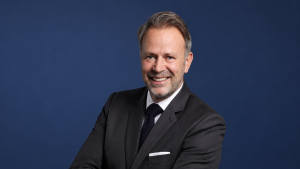
In January 2002, a few months before being appointed Prime Minister, he wrote: "The influence of graduates of the École Nationale d'Administration (ENA) in French political life is such that it calls for a profound reassessment." He didn't attend the ENA. He attended ESCP. He became Prime Minister under Jacques Chirac from 2002 to 2005, championing the "grassroots France" and rural France against a Parisian elite from which, in reality, he wasn't so far removed.
Raffarin at ESCP: a graduating class with Michel Barnier, and the creation of Tribunes
Jean-Pierre Raffarin was born on August 3, 1948, in Poitiers. His father, Jean, was a politician from the Poitou region—a general councillor for the Vienne department, then Secretary of State for Agriculture in the Mendès France government in 1954. Politics was a family tradition. Jean-Pierre attended secondary school at the Lycée Henri-IV in Poitiers, then went to Paris to study law at the University of Paris II Panthéon-Assas, before enrolling at ESCP Business School. He graduated in 1972—in the same class as Michel Barnier, also a future Prime Minister. Two Prime Ministers from the same ESCP graduating class: that's a record.
During his studies at ESCP, Raffarin founded the Tribunes association – a debate and conference group that invited prominent figures to engage with students. He created it in 1969, while still in preparatory school. This initiative reveals something about a man who, throughout his life, would be more comfortable in conversation than with writing briefs. He also completed a year-long internship at the Fébor soap factory in the Eure region during his studies. Not exactly the kind of internship one would expect from a future head of government.
Since 2007, he has been an affiliated professor at ESCP, where he teaches strategy and political issues. The school awarded him an honorary doctorate during its bicentennial. On that occasion, he declared: "You don't let go of the handrail that helps you grow."
Read more: 2024 Budgets of Top Business Schools – Planète Grandes Écoles
What ESCP offers him: the world of business, not the civil service.
Raffarin's profile is constitutionally different from that of his predecessors at Matignon. No ENA, no elite corps, no ministerial cabinet as a springboard. What he has is a business background, a career in the private sector (marketing director of Jacques Vabre coffees from 1973 to 1976, managing director of Bernard Krief Communication from 1981 to 1988), and twenty years of local elected office in Poitou-Charentes.
His ESCP education gave him an understanding of SMEs and commerce – which would be the focus of his first ministerial post in 1995 – and a legitimacy with the business community that few politicians of his time possessed. When he was appointed Minister for SMEs, Trade, and Crafts in 1995, he wasn't discovering these issues for the first time. He was already familiar with them.


Read more: Michel Barnier, ESCP, Prime Minister and Brexit negotiator – Alumnow
Regional president at 40: "grassroots France" as a political project
In 1988, at the age of 40, Jean-Pierre Raffarin was elected president of the Poitou-Charentes regional council – the youngest regional president in France at the time. He remained in office until 2002, a total of 14 years. This long tenure at the regional level is the core of his political legitimacy: he managed a real budget, built infrastructure, negotiated with the national government, and maintained a majority in a region not naturally inclined towards the right wing.
It was there that he forged the rhetoric of the "Republic of Local Communities" and the "France of the People"—phrases that would earn him as much ridicule as recognition. The idea was simple: French politics was too concentrated in Paris, too technocratic, too far removed from local realities. A man from the provinces, a business school graduate, who had managed a region rather than a major ministry, could represent something else.
Read more: Leïla Slimani, ESCP, Goncourt Prize – Alumnow
Matignon 2002-2005: three governments, a pension reform and the "no" vote in the referendum
On May 6, 2002, following Jacques Chirac's re-election in the second round against Jean-Marie Le Pen, Jean-Pierre Raffarin was appointed Prime Minister. He led three successive governments until May 31, 2005. Chirac chose him for his image as a prominent figure from the provinces, not a graduate of the École Nationale d'Administration (ENA), known for his consensus-building approach and close ties to the people.
His term was marked by three major events. The 2003 pension reform—extending the contribution period—was adopted despite strong social mobilization, in a context of rapidly accumulating deficits in the pension systems. The 2003 decentralization law—a constitutional amendment that transferred new powers to the regions and departments—was his reform most faithful to his deep political convictions. And the misstep: the May 2005 referendum on the European Constitutional Treaty, which the "no" vote won with 54.7%. Two days later, Raffarin resigned. Villepin succeeded him.
For ESCP Business School alumni, Raffarin represents a paradoxical figure: a politician who throughout his life championed the school's identity as a business school against the culture of the elite civil service, and who held the highest offices of the Republic without ever compromising on this point. He returned to teach at ESCP after his time at Matignon. He had nowhere else to go.
Frequently asked questions about Jean-Pierre Raffarin
What school did Jean-Pierre Raffarin attend?
Jean-Pierre Raffarin graduated from ESCP Business School (class of 1972), in the same graduating class as Michel Barnier. He did not attend ENA – a point he emphasized as a distinctive feature in the French political landscape.
How long was Jean-Pierre Raffarin Prime Minister?
Jean-Pierre Raffarin served as Prime Minister from May 2002 to May 2005, under the presidency of Jacques Chirac. He led three successive governments. He resigned two days after the "no" vote in the referendum on the European Constitutional Treaty, on May 29, 2005.
What is the Tribunes association founded by Raffarin?
The Tribunes association was founded by Jean-Pierre Raffarin in 1969, when he was a student at ESCP. It is a debate and conference association that invites prominent figures from all backgrounds to engage with students. It is still active at ESCP today.