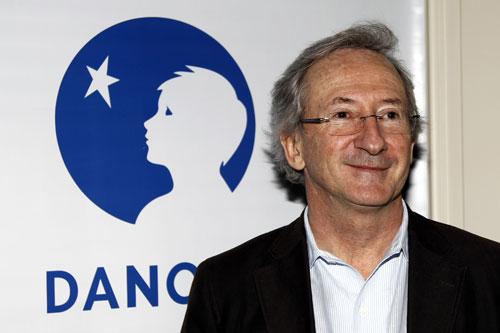
His father, Antoine Riboud, had attended ESCP in Paris. He himself had chosen EPFL in Lausanne. He joined BSN in 1980 upon graduating. Sixteen years later, his father handed over the reins. He then made the most counterintuitive decision imaginable for an heir: rather than diversifying as his father had done, he refocused – selling the biscuit business (LU) to Kraft and acquiring the infant nutrition division (Numico). In 2014, he passed the reins to Emmanuel Faber. The transition had lasted eighteen years.
Riboud at EPFL in Lausanne: Lyon, the Marists and a Swiss choice
Franck Riboud was born on November 7, 1955, in Lyon. His father, Antoine, was then the head of the Souchon-Neuvesel glassworks, which was in the process of building BSN. His family belonged to the old Lyon bourgeoisie. His paternal uncle, Marc Riboud, was a photographer—one of the greatest photojournalists of the 20th century, known in particular for his coverage of Mao's China and Vietnam. His other uncle, Jean Riboud, presided over Schlumberger, the oil services giant, from Paris and New York.
Franck Riboud attended middle school at the Perrache annex of the Lycée Ampère in Lyon, then high school at the Marist school (Sainte-Marie Lyon). He then chose the Swiss Federal Institute of Technology Lausanne (EPFL) for his engineering studies, specializing in mechanical engineering. He graduated in 1980—a rigorous training in engineering sciences at one of the best technical schools in Europe, outside the French Grandes Écoles system.
Read more: Antoine Riboud, ESCP, founder of Danone – Alumnow
Franck Riboud at BSN then Danone: sixteen years in all positions before the presidency
In 1980, upon graduating from EPFL, Franck Riboud joined BSN. There, he followed the traditional career path of a young executive—not the shortcut his name might have offered. He worked in management control at Panzani, marketing at Danone and Evian, and sales at Danone and L'Alsacienne. In 1989, he became director of the department responsible for the integration and development of new companies within the Biscuits division. In 1990, he became managing director of Evian.
This methodical progression through all the roles – sixteen years before becoming president – gave him an operational knowledge of the group that few heirs to the company's legacy possess. He had led sales teams, managed brands, and run an entire subsidiary. When he took the reins in 1996, he knew exactly what he was talking about.


In 1994, BSN adopted the name Danone—the group's most visible brand internationally. In May 1996, for the thirtieth anniversary of the group founded by his father, Antoine Riboud retired and nominated his son to the board of directors. Franck Riboud was elected CEO at the age of 40.
Read more: Emmanuel Faber, HEC Paris, CEO of Danone and responsible capitalism – Alumnow
Franck Riboud, CEO of Danone: refocusing versus diversification
Franck Riboud's major strategic decision was to break with the diversification strategy his father had built. Antoine Riboud had constructed a group that encompassed everything from yogurt and biscuits to beer and bottled water. Franck Riboud chose to refocus.
In 2007, two simultaneous moves marked a clear break. On the one hand, the sale of the biscuit division (LU, BN, Petit Beurre, etc.) to Kraft Foods for over €5 billion. On the other, the acquisition of the Dutch group Numico, a specialist in medical and infant nutrition (Nutricia, Cow & Gate), for €12.3 billion – the largest acquisition in Danone's history. The group then found itself focused on three core areas: fresh dairy products, bottled water, and infant and medical nutrition.
Furthermore, Franck Riboud continued the social commitment he inherited from his father. In 2006, with Muhammad Yunus—the founder of Grameen Bank and Nobel Peace Prize laureate—he launched Grameen Danone Foods in Bangladesh: a social joint venture to produce fortified yogurts affordable for disadvantaged populations. This project, the first of its kind on this scale in the food industry, foreshadowed what his successor, Emmanuel Faber, would call "responsible capitalism."
In 2014, Franck Riboud handed over the CEO position to Emmanuel Faber – who had worked alongside him since 1997. He remained chairman of the board until 2017. During his eighteen years at the helm, Danone's revenue more than doubled. For EPFL alumni, Franck Riboud exemplifies what an engineering education outside of France's elite engineering schools can produce – provided one has sixteen years to learn the profession from the ground up before rising to the top.
Frequently asked questions about Franck Riboud
Which school did Franck Riboud attend?
Franck Riboud graduated from EPFL – the Swiss Federal Institute of Technology Lausanne – with a degree in mechanical engineering (class of 1980). He attended secondary school at the Marist school in Lyon (Sainte-Marie). He joined BSN immediately after graduating from EPFL and has spent his entire career there.
What was Franck Riboud's grand strategy at Danone?
Franck Riboud's major strategic decision was to refocus Danone on three core businesses—fresh dairy products, bottled water, and infant and medical nutrition—at the expense of the diversification he inherited from his father. In 2007, he simultaneously sold the biscuit brands (LU, BN) to Kraft Foods and acquired Numico for €12.3 billion to strengthen the infant nutrition division.
What is Grameen Danone Foods, launched by Franck Riboud?
Grameen Danone Foods is a social joint venture launched in 2006 by Franck Riboud and Muhammad Yunus (Nobel Peace Prize laureate, founder of the Grameen Bank in Bangladesh). Its objective: to produce vitamin- and mineral-fortified yogurt for underprivileged populations in Bangladesh at an affordable price. It is one of the first examples of a large-scale social enterprise in the global food industry.