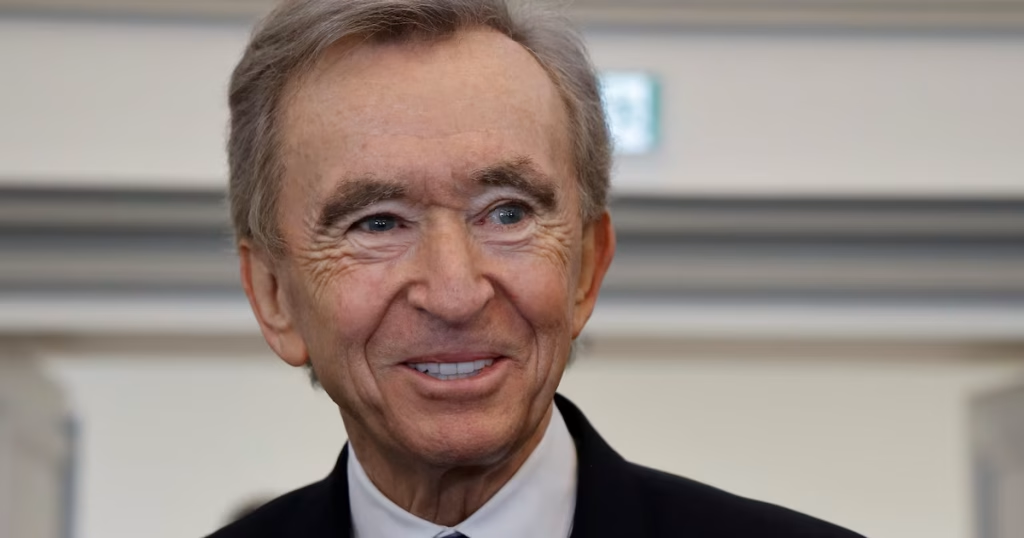
He failed his entrance exam for Polytechnique in his first year – because of a broken arm. He returned the following year and was accepted. Since then, he has built the world's leading luxury group, been the world's richest person several times according to Forbes, and an empire of 75 brands that no one had imagined possible from Paris.
Bernard Arnault at Polytechnique: an engineering education for a predator's instinct
Bernard Jean Étienne Arnault was born on March 5, 1949, in Roubaix. His father, Jean, was an engineer and graduate of Centrale Paris, who ran the family business, Ferret-Savinel, specializing in public works. His mother was the daughter of the founder of the same company. Young Bernard grew up between the factories of northern France and piano lessons—an artistic discipline he practiced seriously and which, he would later say, influenced his approach to product perfection.
In preparatory school, he aimed for the École Polytechnique. First attempt: accepted, present for the written exams, present for the oral exams – but absent for the physical tests, which were elimination rounds at the time. The reason: a fall in the entrance hall of his parents' house. A broken arm. End of the competition. He would offer several versions over the years – a fall from a horse, a high jump – before the truth, far less romantic, finally came to light.
He retook the exam the following year. Passed. He entered École Polytechnique (X) in 1969 and graduated in 1971, then completed his studies at the École des Mines de Paris as an application school – the standard path for Polytechnique graduates aiming for industry. At Polytechnique, he wasn't a remarkable student. Brilliant upon entry, he ended up being just average in his class. This isn't uncommon: the entrance exam selects people capable of extreme intensity over two years. What the school does with them afterward is another story.
What Polytechnique brings to Bernard Arnault – and how he uses it
What Polytechnique gives him is not knowledge of the luxury industry – nothing in the training of a Polytechnique engineer prepares him to run a fashion house. What it gives him is a way of breaking down a complex problem into manageable elements, of reasoning in systems, of quantifying where others reason by instinct.
When Arnault acquired a stake in LVMH in 1989, behind the backs of the founding families, the operation resembled a demonstration of financial engineering as much as a gamble. He modeled the capital structures, identified the weaknesses in the shareholders' agreement, and calculated the threshold at which his stake would become indispensable. The intuition of a hunter, the methodology of an engineer. The École Polytechnique provided the latter.
Read more: Jean-Marc Jancovici, Polytechnique, Climate and Shift Project – Alumnow
Arnault de Ferret-Savinel to Christian Dior: the two decisive pivots
Upon graduating from École Polytechnique in 1971, Arnault joined the family business. He became construction director in 1974, managing director in 1977 at the age of 27, and CEO in 1978 after convincing his father to shift the company towards property development. He renamed Ferret-Savinel to Férinel. The French construction industry in the 1970s was under pressure. Tourist real estate offered better profit margins. He was right.


In 1981, Mitterrand's election worried him. He went to the United States and set up a real estate project in Palm Beach with a local developer – Donald Trump. The deal quickly fell through. He returned to France in 1984, not much richer but with an intimate understanding of the American market that would prove useful twenty years later when LVMH launched Louis Vuitton on a large scale there.
In 1984, the Fabius government sought a buyer for Boussac, the bankrupt textile conglomerate that controlled Christian Dior. Arnault submitted a bid, promised to maintain jobs, and acquired the group for a symbolic one franc with state support. He then sold almost all of the textile assets and kept Dior. Not all jobs were saved. The deal remains controversial. The brand, however, became the foundation of everything that followed.
Read more: Patrick Pouyanné, Polytechnique, CEO of TotalEnergies – Alumnow
The takeover of LVMH in 1989: the most audacious move in the history of French luxury
In 1987, Louis Vuitton and Moët Hennessy merged to form LVMH. The merger was difficult: the founding families – Vuitton, Moët, and Hennessy – clashed for control. The Lazard bank attempted a maneuver to protect the historical families. Arnault watched.
He partnered with the Guinness group, gradually increasing his stake in the company without anyone realizing the extent of his influence. By 1989, he held a majority stake. At 40, he was CEO of LVMH. The operation was carried out discreetly, with a precision that only someone trained to analyze complex systems could have achieved. The press called it a power grab. It was primarily a matter of engineering.
The LVMH empire under Arnault: 75 brands and the world's largest fortune
What follows is the logic of a patient predator. Givenchy in 1988, Céline in 1996, Sephora in 1997, Guerlain in 1994, TAG Heuer in 1999, Bulgari in 2011 for $4.3 billion, Tiffany & Co. in 2021 for $15.8 billion – the largest acquisition in the history of global luxury. Each acquisition follows the same criterion: a brand with a long history, artisanal or creative legitimacy, and untapped potential for moving upmarket.
In 2023, Forbes ranked him the world's richest person with over $200 billion – ahead of Elon Musk and Jeff Bezos. LVMH's market capitalization exceeded €400 billion, and it generated over €86 billion in revenue in 2023. The graduate of the École Polytechnique in Roubaix became the richest man on the planet.
Meanwhile, the Louis Vuitton Foundation, opened in 2014 in the Bois de Boulogne in a building designed by Frank Gehry, houses one of the most important contemporary art collections in Europe. This is not mere superficial patronage: Arnault has been collecting for thirty years, using the same method he applies to corporate acquisitions – identify early, buy at the right time, and hold on for the long term.
Read more: Xavier Niel, Polytechnique, Free and the 42 school – Alumnow
Frequently asked questions about Bernard Arnault
Which school did Bernard Arnault attend?
Bernard Arnault graduated from École Polytechnique (class of 1969), leaving in 1971. He then completed his training at École des Mines de Paris as an application school, before joining the family company Ferret-Savinel.
How did Bernard Arnault take control of LVMH?
In 1989, taking advantage of a conflict between the founding families of LVMH, Arnault allied himself with the Guinness group and gradually increased his stake until he held a majority share. The operation, conducted discreetly over several months, took everyone by surprise. At 40, he became chairman of the group.
How many brands does LVMH have today?
LVMH comprises more than 75 brands across six divisions: wines and spirits, fashion and leather goods, perfumes and cosmetics, watches and jewelry, selective retailing, and media. These include Louis Vuitton, Dior, Givenchy, Bulgari, Tiffany & Co., Moët & Chandon, Hennessy, and Sephora.