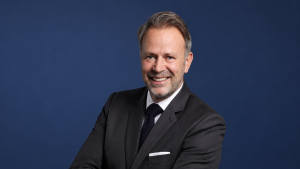
He titled his autobiography "The Last in the Class." His father had excused him from taking the baccalaureate exam. At ESCP, he admitted his studies were "rather mediocre." In 1968, he launched the first hostile takeover bid in the history of the Paris Stock Exchange for Saint-Gobain—a company five times larger than his own. And in 1972, he delivered a speech on corporate social and environmental responsibility—15 years before Brundtland. Antoine Riboud built Danone from a provincial glassworks.
Antoine Riboud at ESCP: last in his class and a father who saved him from taking the baccalaureate exam
Antoine Riboud was born on December 24, 1918, in Lyon, into a family of the city's upper middle class. His grandfather had been one of the founders of the Lyonnaise de Banque. His brothers, Marc Riboud and Jean Riboud (future chairman of Schlumberger), would also leave their mark on their century – the former as a renowned photographer, the latter as an internationally acclaimed business leader . Antoine attended the Lycée Ampère in Lyon for his secondary education, then went on to study at the École Supérieure de Commerce de Paris – now ESCP Business School.
His father, believing Antoine's failure in the baccalaureate exam was inevitable, had excused him from taking it—a detail that fueled a lifelong sense of self-deprecation. At ESCP, he completed what he himself described as rather mediocre studies. This chaotic academic journey is at the heart of his 1999 autobiography, *Le Dernier de la classe* (The Last in the Class)—a title that conveys both humor and a message: grades say nothing about what you're going to do.
Read more: 2024 Budgets of Top Business Schools – Planète Grandes Écoles
Riboud from the glassworks to BSN: learning on the job and the takeover bid for Saint-Gobain
In 1942, at the age of 24, Antoine Riboud joined Verreries Souchon-Neuvesel, a family business producing glass bottles headquartered in Lyon. There, he learned the trade on the job – salesman, general secretary, director. In 1965, he became its president, also assuming the presidency of the Société des eaux minérales d'Évian, in which the glassworks held a stake.
In 1966, he merged Souchon-Neuvesel with Glaces de Boussois – a glass manufacturer – to create the BSN group (Boussois-Souchon-Neuvesel). Then, at the end of December 1968, he launched a takeover bid for Saint-Gobain – five times larger than BSN. It was the first hostile takeover bid in the history of the Paris Stock Exchange. The operation failed. But it made Antoine Riboud famous throughout the French industrial world – he was the one who had dared.
Read more: Michel Barnier, ESCP, Prime Minister and Brexit negotiator – Alumnow


Riboud and the Marseille speech of 1972: father of sustainable development in business
In 1972, at the conference of the French National Employers' Council in Marseille, Antoine Riboud delivered a speech that would go down in management history. He formulated what was then called "corporate social responsibility":
"Let's run our businesses as much with our hearts as with our heads, and let's not forget that while the earth's energy resources have limits, those of man are infinite if he feels motivated."
This speech was given 15 years before Gro Harlem Brundtland, the Norwegian Prime Minister, popularized the concept of sustainable development in her 1987 report for the United Nations. Riboud had anticipated the conceptual framework that now structures all thinking on corporate governance. His son Franck, and after him Emmanuel Faber, continued along this path – culminating in the company's achievement of the "Entreprise à Mission" (Purpose-Driven Company) status in 2020.
Read more: Jean-Pierre Raffarin, ESCP, Prime Minister – Alumnow
From glass to Danone: the most audacious strategic reconversion in French capitalism
Faced with the rise of plastic packaging in the 1970s, Antoine Riboud made a radical strategic decision: to abandon glass and pivot to the food industry – a sector that, precisely, used a great many hollow glass bottles. In 1970, BSN acquired Kronenbourg and Evian. In 1972, he met Daniel Carasso, CEO of Gervais-Danone. In June 1973, he oversaw the merger between BSN and Gervais-Danone – creating France's leading food company.
In the following years, he acquired LU and Belin (biscuits), strengthened Évian and Kronenbourg, and developed fresh dairy products. In 1994, he made the final decision: to replace the BSN name—unknown outside France—with that of his main brand, Danone, which had become a global name. In May 1996, for the group's thirtieth anniversary, he retired and handed the reins to his son, Franck Riboud.
Antoine Riboud died on May 5, 2002, in Paris, at the age of 83. In thirty years, he had transformed a provincial glassworks into a food group with a turnover of 14 billion euros and 100,000 employees worldwide. For ESCP alumni, he remains proof that a mediocre education says nothing about what a business leader is capable of building – and that a speech given in Marseille in 1972 can precede major international pronouncements by fifteen years.
Frequently Asked Questions about Antoine Riboud
Which school did Antoine Riboud attend?
Antoine Riboud studied at the École supérieure de commerce de Paris, now ESCP Business School. He himself described his studies as "rather mediocre," and used this as the title of his autobiography, *Le Dernier de la classe* (1999). His father had excused him from taking the baccalaureate exam.
What was Antoine Riboud's Marseille speech of 1972?
In 1972, at the CNPF conference in Marseille, Antoine Riboud delivered a speech on corporate social and environmental responsibility, asserting that the Earth's resources were finite but that human potential was infinite if motivated. This speech is considered a precursor to the concept of sustainable development, formulated 15 years before the Brundtland Report (1987) popularized it internationally.
How did Antoine Riboud found Danone?
Antoine Riboud inherited a family glassmaking business (Souchon-Neuvesel) which he developed into the BSN group in 1966. Faced with the rise of plastic packaging, he pivoted to the food industry, acquiring Kronenbourg and Evian in 1970, before merging BSN with Gervais-Danone in June 1973. In 1994, he rebranded the group as Danone, transforming it into a global brand. At his departure in 1996, the group had a turnover of €14 billion.