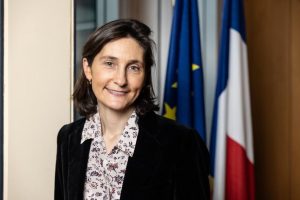
Her 48.25 seconds in Atlanta in 1996 remained the Olympic record for the 400 meters for 28 years, until the Paris Games in 2024. She is the only French athlete to have won three Olympic titles. After retiring from competition, she resumed her studies and earned a master's degree in sports management from ESSEC in 2007. And on July 26, 2024, she lit the Olympic cauldron over Paris, alongside Teddy Riner . Marie-José Pérec has done it all—right-side up and upside down.
Pérec at ESSEC: a master's degree in sports management after his career
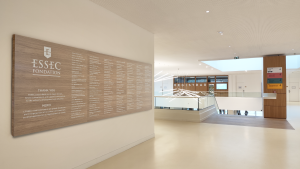
Marie-José Pérec's connection to ESSEC is not through the Grande École program. It's a master's degree in sports management, obtained in 2007, after the end of her athletic career in 2004. This decision—returning to her studies at 39, three years after hanging up her spikes—speaks volumes about a woman who didn't rely solely on her sporting achievements to build her future.
She herself now emphasizes that modern athletes are fortunate to be able to pursue studies and sport simultaneously – an opportunity she didn't have, having dedicated her competitive years exclusively to training. The ESSEC master's program provided her with the tools to think of sport as an industry, to understand the economic stakes of federations, events, and TV rights – essential vocabulary for her work as a consultant and sports ambassador.
Read more: Marie-José Pérec: from legend to last bearer of the Flame – Planète Grandes Écoles
Pérec before ESSEC: Basse-Terre, Paris at 19, and a PE teacher who changed everything
Marie-José Pérec was born on May 9, 1968, in Basse-Terre, Guadeloupe. She wasn't destined to become an athlete. She tried basketball and ran casually in the schoolyard. It was a physical education teacher who, recognizing her natural talent, convinced her to participate in a few races. She dominated the competition without even trying. This late breakthrough—she didn't join the INSEP (National Institute of Sport, Expertise and Performance) until she was 16—made her an athlete who developed later in life, without the years of early training that often shape sprinters.
In 1987, at the age of 19, she moved to Paris. Coach François Pépin recognized her potential and took her under his wing. In 1988, she broke the French 400-meter record with a time of 51.35 seconds. In 1991 in Tokyo, she became world champion in the 400 meters for the first time – 49.13 seconds, the eighth-best performance in the world at the time. France discovered an exceptional sprinter.


Read more: Clarisse Agbegnenou, HEC Paris, Olympic judo champion – Alumnow
Atlanta 1996: the 200m-400m double that redefined the limits of sprinting
At the 1992 Barcelona Games, Pérec won the 400 meters in 48.83 seconds. Her first Olympic title. In 1994, she changed coaches and joined the John Smith group in Los Angeles – the same group that coached Maurice Greene, Ato Boldon, and Quincy Watts. In complete secrecy, she also trained for the 200 meters.
On July 29, 1996, in Atlanta, she won the 400 meters in 48.25 seconds – a French record, the seventh-fastest time ever, and an Olympic record that would stand until 2024. Three days later, she beat Jamaican Merlene Ottey in the final straight of the 200 meters (22.12 seconds). She achieved the same 200m-400m double as Michael Johnson in the men's competition – a unique feat in the history of women's Olympic athletics. In 1995 and 1996, she held the French records in the 200m, 400m, 400m hurdles, and 4x400m relay. Four events. One woman.
Sydney 2000, the start and end of a career
In 1998, she contracted the Epstein-Barr virus, which caused heart complications. She was absent from the slopes for two years. She returned in 2000, preparing for Sydney with a new coach in Rostock. Her anticipated duel with Australian Cathy Freeman – the home favorite, celebrated as a national heroine – was billed as a historic moment.
But Pérec was harassed by the Australian media from the moment she arrived in Sydney. She felt threatened and extremely anxious. On September 20, 2000, she left Sydney for Paris without having run a single race. The controversy was worldwide. She would never return to that level of competition. In June 2004, she officially announced her retirement from sports.
For ESSEC alumni, Marie-José Pérec's journey exemplifies a conviction the school champions in its sports programs: athletic careers and academic training are not opposed, but complementary. Pérec proved that one can return to studies at 39, after having been the world's best sprinter, and that this master's degree is valuable. And on July 26, 2024, alongside Teddy Riner, she lit the Olympic cauldron at the Paris Games—above the Seine, in front of the entire world. The final act of a career that continues to leave its mark.
Frequently Asked Questions about Marie-José Pérec
What is Marie-José Pérec's connection with ESSEC?
Marie-José Pérec holds a Master's degree in Sports Management from ESSEC Business School, which she obtained in 2007 after the end of her athletic career. This was not the traditional Grande École program, but a specialized course she completed after her official retirement from sports in 2004.
Why did Marie-José Pérec leave Sydney in 2000?
Marie-José Pérec left Sydney on September 20, 2000, without having participated in the Olympic Games. She explained that she had been harassed by the Australian media and felt threatened, in a state of anxiety that prevented her from competing under good conditions. She had been treated for mononucleosis (Epstein-Barr virus) in 1998, and her preparation had been disrupted.
How many Olympic titles did Marie-José Pérec win?
Marie-José Pérec is a triple Olympic champion: gold in the 400m at Barcelona 1992 (48.83 seconds), gold in the 400m and gold in the 200m at Atlanta 1996 (48.25 and 22.12 seconds respectively). Her 48.25-second 400m time remained an Olympic record until the Paris 2024 Games. She is the only French athlete to have won three Olympic titles in athletics.