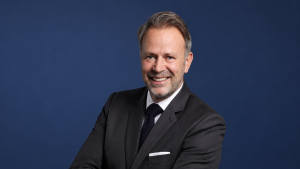
In 2016, the European Union had to choose someone to negotiate Brexit with the United Kingdom – the most complex negotiations in the history of European integration. It chose a man with a business school degree, not from the École Nationale d'Administration (ENA). Nor from Sciences Po. Michel Barnier, ESCP class of 1972, spent four years standing up to the British. He then spent 99 days at Matignon – the shortest term in the history of the Fifth Republic.
Barnier at ESCP: a Gaullist at 15, a business student in Paris at 20
Michel Barnier was born on January 9, 1951, in La Tronche, Isère. His father ran a small leather goods business, and his mother was involved in community organizations. Nothing in this modest background suggested he would one day be on the European stage. What shaped Michel Barnier from a very young age was Gaullism – he joined the General's movement at 15, fascinated by a particular vision of France and Europe.
He attended Lycée Jean-Moulin in Albertville, then Lycée du Parc in Lyon – one of the best public high schools in France – and finally ESCP Business School in Paris, graduating in 1972. In the same graduating class was Jean-Pierre Raffarin, also a future Prime Minister. A coincidence that speaks volumes about the caliber of ESCP at the time.
He was interviewed on television in 1971, while still a student at ESCP. He had just been appointed to the High Committee for Youth, Sports, and Leisure—at the age of 20. A video from the INA (National Audiovisual Institute) confirms this. He wasn't a student preparing for a business career. He was someone who was involved in politics while simultaneously taking management courses.
Read more: ESCP Business School: new programs and innovations – Planète Grandes Écoles
What ESCP brings to Barnier – and what activism teaches him in addition
Barnier's profile is atypical for a man who would reach the highest offices of the French and European state: no ENA (National School of Administration), no Sciences Po, no elite civil service corps. A business school and fifty years of political experience. Of the 190 ministers France had between 2000 and 2018, only 6% came from elite business schools. Barnier belongs to this minority.
What ESCP gave him was an understanding of economic mechanisms – trade policy, market regulation, international trade – which would be central to his successive ministerial portfolios (Environment, Agriculture, European Single Market). But it was above all his activism at age 15, the local meetings in Savoy, the leaflets, the ministerial offices before the age of 30, that shaped his political instincts.
Read more: Alexandre Ricard, ESCP, CEO of Pernod Ricard – Alumnow


Savoy, the Albertville Olympics and the Barnier Law: thirty years of territorial roots
His political career began in Savoy. In 1982, at the age of 31, he became the youngest president of the departmental council in its history. That same year, he joined forces with three-time Olympic champion Jean-Claude Killy to co-chair the organizing committee for the 1992 Albertville Winter Olympics. Ten years of work for a sixteen-day event – the experience taught him how to manage complex projects on an international scale, with non-negotiable deadlines.
In 1993, appointed Minister of the Environment in the Balladur government, he passed the Barnier Law – a landmark piece of legislation that created the National Commission for Public Debate on major infrastructure projects and laid the foundations of the precautionary principle in French law. It is one of the few laws bearing the name of its minister that is still regularly cited thirty years after its adoption. He would later revisit this issue by creating a Barnier tax on maritime transport to finance the protection of natural areas.
Read more: Leïla Slimani, ESCP, Prix Goncourt – Alumnow
Brexit: Four years to maintain a consistent stance towards London
In 2016, following the British referendum, the European Union tasked Michel Barnier with leading the Brexit negotiations on its behalf. The choice was significant: the EU wanted someone who knew the European institutions from the inside (he had served twice as a European Commissioner), who was well-versed in economic and financial matters, and who would not yield to British pressure.
For four years, Barnier held firm to one line: no leaving the single market without respecting its rules. No free trade agreement without a safety net for Ireland. The British changed Prime Ministers three times (May, Johnson, Truss). Barnier, however, remained steadfast. The agreement was finalized on December 24, 2020, Christmas Eve. His handling of the matter earned him an international reputation as a relentless, methodical, and patient negotiator.
Matignon 2024: 99 days and a motion of censure
On September 5, 2024, Emmanuel Macron appointed him Prime Minister at the age of 73 – the oldest person ever appointed in the history of the Fifth Republic. The context was one of a National Assembly without a clear majority, following its dissolution in June 2024. Barnier formed a moderate right-wing government and attempted to implement a policy of fiscal austerity.
On December 4, 2024, a vote of no confidence, supported by the left and the National Rally, ousted him. His government lasted 99 days—the shortest term of a Prime Minister under the Fifth Republic. A record no one wanted. Barnier submitted his resignation with the same composure he had displayed during the Brexit negotiations: without drama, without excessive commentary.
For ESCP Business School alumni, Michel Barnier embodies a career path that contradicts a persistent prejudice: that one can reach the highest positions in the French state and Europe without having attended the ENA (National School of Administration). What he has built instead—fifty years of political experience, an insider's knowledge of European institutions, and a reputation for long-term stability—is far more valuable than a top-tier graduate's ranking.
Frequently asked questions about Michel Barnier
Which school did Michel Barnier attend?
Michel Barnier graduated from ESCP Business School (then the École Supérieure de Commerce de Paris), class of 1972. He was in the same graduating class as Jean-Pierre Raffarin, also a future Prime Minister. He did not attend ENA or Sciences Po, which is very unusual for a politician who has reached his level of responsibility.
What was Michel Barnier's role in Brexit?
Michel Barnier was the European Union's chief negotiator for Brexit from 2016 to 2021. He led the negotiations with the United Kingdom on behalf of the 27 member states, resulting in the trade and cooperation agreement signed on December 24, 2020.
How long was Michel Barnier Prime Minister?
Michel Barnier served as Prime Minister from September 5 to December 13, 2024, a total of 99 days – the shortest term in the history of the Fifth Republic. His government was brought down by a vote of no confidence passed by a coalition of the left and the National Rally.