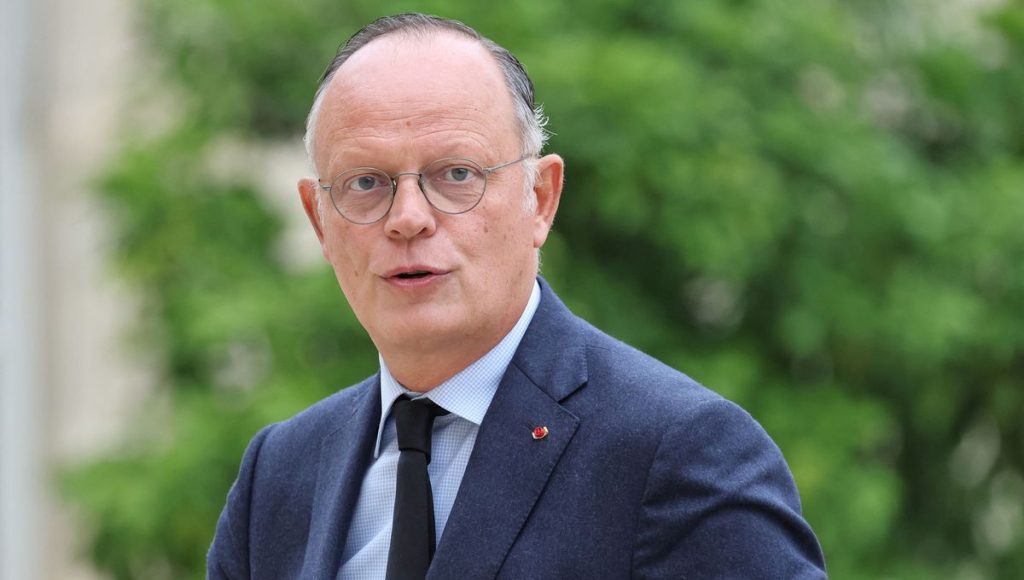
His parents were both French teachers. He had completed preparatory classes for the elite French universities, then attended Sciences Po, and finally the ENA (National School of Administration). He became mayor of Le Havre before achieving national recognition. On May 15, 2017, Emmanuel Macron had just called him to offer him the position of Prime Minister. His beard and hair, brown when he entered the Hôtel de Matignon, had turned white in real time during three years of crises—the Yellow Vest movement, pension reform, and the Covid pandemic. Édouard Philippe had been one of the most popular Prime Ministers of the Fifth Republic. He remained so afterward.
Philippe at Sciences Po and ENA: Rouen, the teachers and the Marc Bloch class
Édouard Philippe was born on November 28, 1970, in Rouen. His father was a French teacher, and his mother taught classical literature. He grew up in Normandy, spent part of his schooling in Germany where his father had been transferred, and returned to France for his preparatory classes for the grandes écoles. He enrolled at Sciences Po Paris and graduated in 1992. At Sciences Po, he briefly frequented clubs associated with the Rocardian wing of the Socialist Party—Michel Rocard was Prime Minister at the time. His political convictions gradually shifted to the right.
He entered the ENA (National School of Administration) and graduated in 1997 as part of the Marc Bloch class. His excellent ranking upon graduation allowed him to join the Council of State, assigned to the litigation section, where he specialized in public procurement law. His classmates in the Marc Bloch class included future senior civil servants and ministers who would go on to work through the same decades in different spheres.
Read more: Sciences Po Paris: the 2025 academic year will be marked by excellence – Planète Grandes Écoles
Philippe before Matignon: Juppé, Le Havre and the journey of the loyalist
In 2001, Philippe left the Council of State to join the municipal team of Le Havre mayor Antoine Rufenacht. In 2002, he participated in the creation of the UMP alongside Alain Juppé, becoming its director general. He remained one of Juppé's most steadfast supporters for fifteen years – until the 2016 right-wing primary, where he served as spokesperson for the Juppé campaign, before rallying behind François Fillon and then withdrawing from the party when the fictitious jobs scandal broke.


Between 2005 and 2010, he alternated between the law firm Debevoise & Plimpton, a stint as an advisor to Alain Juppé, Minister of the Environment (2007), and the public affairs department of Areva (2007-2010). In October 2010, he succeeded Antoine Rufenacht as mayor of Le Havre. He was re-elected in the first round in 2014. Le Havre became his stronghold and his testing ground: port development policy, dialogue with economic stakeholders, and the balance between urban attractiveness and sustainable development.
Read more: Emmanuel Macron, Sciences Po Paris, President of the Republic – Alumnow
Prime Minister Philippe: three years, three crises, a white beard
On May 15, 2017, Emmanuel Macron appointed Édouard Philippe as Prime Minister—a right-wing (LR) member of parliament—to head the government of the En Marche! president. The choice was politically bold: to blur the lines between right and left, to embody openness and administrative competence. Philippe led two successive governments until July 3, 2020.
His term was marked by three major crises. The Yellow Vest movement, beginning in November 2018, was addressed by him implementing a six-month moratorium on fuel tax increases, followed by a major national debate. The pension reform in 2019-2020 was defended against massive opposition, resorting to Article 49.3 of the French Constitution. The Covid-19 pandemic, beginning in March 2020, saw him announce lockdown measures, manage the mask shortage, and orchestrate the lifting of restrictions. His approval rating surpassed Macron's on several occasions. His beard and hair, brown in May 2017, turned completely white during these three years.
In July 2020, re-elected mayor of Le Havre, he left Matignon. In 2021, he founded Horizons, a center-right party intended to structure his own political platform. For alumni of Sciences Po Paris and the ENA (National School of Administration), Édouard Philippe embodies the model of the senior civil servant who chose local roots over national visibility—ten years in Le Havre before Matignon—and who returned there afterward. His understated, methodical, literary style (he has published two novels and an essay) speaks volumes about what the Sciences Po-ENA path can produce when it is nurtured by a family of literature teachers.
Frequently asked questions about Édouard Philippe
What school did Édouard Philippe attend?
Édouard Philippe graduated from Sciences Po Paris (1992) and the ENA (Marc Bloch class of 1997). He completed a preparatory course for the École Normale Supérieure (hypokhâgne) before Sciences Po. Upon graduating from the ENA, he joined the Council of State, specializing in public procurement law.
Why was Édouard Philippe appointed Prime Minister by Macron in 2017?
Emmanuel Macron had chosen Édouard Philippe, a member of parliament for the Republicans (LR) and mayor of Le Havre, to embody his government's outreach to the Republican right and blur traditional political lines. Philippe was known as a loyal supporter of Alain Juppé, administratively competent, and deeply rooted in the local community. His appointment had surprised even members of his own party.
What did Édouard Philippe do after Matignon?
Édouard Philippe was re-elected mayor of Le Havre in July 2020, a few days after leaving Matignon. In 2021, he founded Horizons, a center-right party. He has since held the dual positions of mayor of Le Havre and president of Horizons, while remaining a figure regularly mentioned as a potential candidate for the 2027 presidential election.